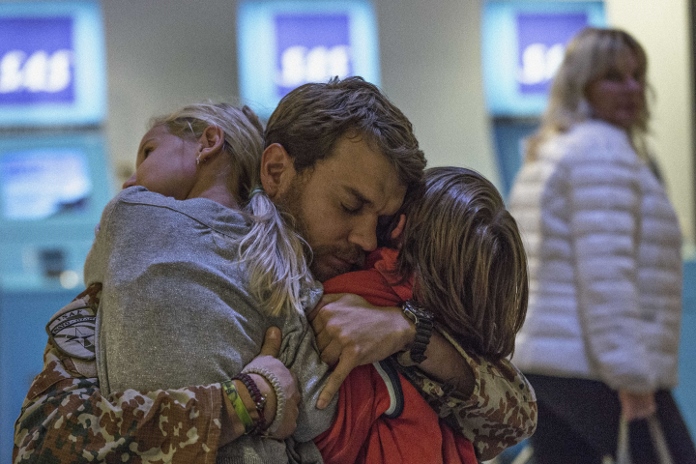
Tobias Lindholm and Pilou Asbæk, director and star of Oscar nominee “A War”
Combat and Consequence
Feb 23, 2016 Web Exclusive
Two years ago, Danish writer/director Tobias Lindholm got a taste of Academy Award recognition when The Hunt, a film that he co-wrote with its director, Thomas Vinterberg, was nominated for Best Foreign Language Film. This year, Lindholm’s own film, A War, about a Danish company commander put on trial for war crimes alleged to have occurred in Afghanistan, also has been nominated for Best Foreign Language Film.
A War is the third feature-film collaboration between Lindholm and lead actor Pilou Asbæk, who will be seen in the upcoming season of Game of Thrones. They first worked together on the prison drama, R, which Lindholm co-wrote and co-directed with Michael Noer. That was followed by Asbæk appearing in two seasons of the TV series, Borgen, for which Lindholm shared story credits with other writers. Lindholm’s second feature, the exceedingly tense 2012 thriller, A Hijacking, earned rave reviews internationally, with Asbæk playing a merchant ship cook whose life is persistently threatened by Somali pirates as contentious negotiations with the shipping company drag on for weeks.
In A War, Asbæk plays Claus M. Pedersen, a tough but compassionate Danish company commander stationed in Afghanistan whose absence is causing difficultly for his wife and children back home. When his fellow soldiers are besieged during a mission, he must make an impossible choice between protecting his men and keeping a promise to Afghan civilians.
Under the Radar spoke with Lindholm and Asbæk in Los Angeles last November.
Chris Tinkham (Under the Radar): What sparked the idea for this film? Did it come from news stories that you read?
Tobias Lindholm: I knew since Denmark went into Afghanistan and Iraq just after 9/11 that we would need to make a film about that at one point. So from that point on, I was looking for stories, but I knew that I didn’t want to make a story of how humans are de-humanized throughout war—we’ve seen that stuff. And then one day I read an article about a Danish officer going on his third term to Afghanistan, and he said, “I’m not afraid of getting killed down there; I’m afraid of getting prosecuted when I get back home because the rules are so strict now. So it’s almost impossible to do my job.” Wow, that’s it. That’s the story. And that became the starting point for A War.
What was the initial public opinion about Denmark’s involvement in the war, and has it changed dramatically through the years?
Lindholm: Right now, we are in a small-scale, post-Vietnam phase in Denmark where we are looking at what actually happened. We’ve been in peace-keeping missions in Kosovo and those places, but to actually have professional soldiers going in and fighting a war on strange territories, far away from home, is a totally new thing. So I’m not sure that the Danish population knew exactly what to think of it. I think there was a lot of sympathy toward the U.S. because of 9/11. I think that everybody felt that the world is changing now. But people in Denmark had no idea what it would mean to send soldiers into a war. And as soon as we started to have soldiers coming home, the situation changed. People started to question. And that’s been the case ever since. It’s been a debate whether you are pro or against this war. What we tried to do with this film was to nuance that into a conversation about what actually happened. The fact is, the war’s over. We have only training personnel left in Afghanistan. So now is not the time to discuss whether we should have done it or not, but just look at what happened. We did it. How can we move on? How can we reclaim these homecoming soldiers in our society? How can we understand what they’ve been through, and how can we, as a society, live with whatever happened?
Had you two known each other prior to working on R?
Lindholm: No. We got to know each other in that casting process.
How did that go?
Pilou Asbæk: That’s six years ago. The thing is, with Tobias and I, we come from two very different worlds. To put it mildly, personally, we didn’t like each other at all. But, working-wise, we connected big time, which was kind of weird, because I like being sort of sensitive and soft and cuddly. Tobias likes efficiency, work ethic, and to be tough. But after two days of rehearsing, I found out that to create the character, he had to be the actor’s director and Michael be the visual director somehow. And the casting was maybe one of the worst castings you’ve ever seen. It was terrible.
Lindholm: That’s not true—which is why Pilou got the part. We are from very different worlds. Our friendship was not naturally given. There would have been no way for us to meet if we weren’t doing this film together. I come from a small, social-project town 200 kilometers out of Copenhagen. Pilou is from an art gallery family. Pilou was the kind of people I didn’t like when I moved to the city. There’s the thought that they had everything given [to them]. Of course, I realized that wasn’t the truth, and slowly we realized that we were pretty much alike when it came to it. This is eight years ago, almost, because it was me out of film school. It premiered six years ago.
Asbæk: Oh yeah
Lindholm: So, it’s a long time, and basically, during rehearsing, preproduction, I realized that he was an extremely skilled actor. But during the shooting, seeing how much he risked and how much I risked doing that film, brought us very close together. I remember I almost had anxiety attacks months after we ended shooting because I wasn’t in contact with him anymore. I just became addicted to the friendship and that common space we had found as artists. That made it clear for me that whenever I’m writing a film for myself, I’m writing a film for Pilou. Then I can only wish for him to say yes.
Asbæk: It’s funny, the period I hate the most when we have a collaboration is when he’s doing the editing, because he needs to focus on the character, on the role, on the story he’s telling, and if I’m sitting every single day, and I want to have dinner with him and his wife and his family, it doesn’t work. So, we have a rule that was created doing R: that when he’s editing, we have no contact at all.
Lindholm: The crazy thing is, for me it feels like I’m seeing you every day anyway.
Asbæk: But I’m not. So I don’t get the anxiety of Tobias. But it’s funny.
Tobias, if you two didn’t like each other initially, why cast Pilou?
Lindholm: Because, we had other guys auditioning, and the only one that was honest in that casting was Pilou. So that forced me to like him, or, in the beginning, respect him and understand why we should do this film together. Especially his second audition. It’s not like I didn’t like him, but we just didn’t have the chemistry. It was not like, “There’s a friendship here.” It was more like, “OK, you have to do what I say. Please do it, don’t question me.” That kind of authority thing. And it grew from there. What we realized was there was an emotional respect. The friendship just grew. And now it’s this brotherhood where our families are familiar, and I know Pilou’s parents, and we go to each other’s kids’ birthdays, and we spend as much life as we can together—which is a great gift. We don’t have careers, we have lives. You want to spend your life with people you love.
Asbæk: That’s true.
Lindholm: So that’s what we do, and we make films together. Hopefully we can continue doing that once in a while. While we’re both playing in other bands as well, we can get together every third or fourth year and do a project.
Pilou, how has the collaboration changed through the years? Tobias mentioned writing the part of Claus for you. When that happens, do you become involved earlier than production?
Asbæk: No. Tobias went to school as a writer, and then he became a director. Now he’s a writer/director. My job is the character. It’s not my job to do the big storylines, because he has a thousand thoughts about this. I don’t come in and say maybe we need a pink elephant. That’s not how it works. He presents the characters to me, I read it, we agree how we see him visually, and then I go and I do my homework. I’m a professional actor, so I do my homework. Then I come, I present it for him. He says, “This is good, this is good, this is good,” and then we start shooting. We have never ever discussed background story on a character. Never. Why should we?
Lindholm: I don’t believe in character background stories. It’s like a bad excuse for not being present. When I meet you for the first time, I don’t have your background story, but I can definitely feel you on a human level, understand something about this gentleman sitting in front of me. And I do believe that we feel the same way with characters in films. They present themselves through what they do. And that’s not, in my world, dictated from the past. It’s dictated by what’s happening right now and how you react to the person you’re in. And talking too much about background often forces you to try to express that background. It becomes an element, and that element can often be in the way of actually telling the story. Of course there are structures and stories that are built because of a path, and you need to discover that path. But, in what we do, I wouldn’t care what Claus’ parents’ names were. I don’t really care whether he has brothers or sisters. What I’m looking at is a family father who’s a soldier, and let’s just define him by that, by what we see and what we hear. I will say that, with R, I didn’t call Pilou to say, “I have an idea of a prison film.” He came in after the script was done, and the movie was ready to go in many ways. In both The Hijacking and A War, I’ve been calling Pilou saying, “I’m writing this. Do you want to be a part of it?” And telling you the story again and again. And then stuff changes and I add something. I use you as a mirror in many ways, because for me to tell the story helps me to understand it and feel: When is it going dead? Where is it alive? What works as storytelling? We do that together. And then, we just know each other’s path. It’s the third film, so we don’t talk that much during it. It’s like free jazz. Guys that have been playing together 10 years, they start to know each other and know what they’re doing, and they will be able to build music onstage right there. And sometimes I feel that way when we shoot.
Asbæk: But still pushing each other, still not satisfied. “It could be written better.” “No, it can be acted better.” I’m the actor, and he’s the director, so we can have fights, we can discuss things. With the last one, it was very smooth. I remember you calling me after R, and we did Borgen, the TV series together, you said, “I want to do a war film.” And then you explained some themes in it that you wanted to create. I thought it was great. And then you got the idea for A Hijacking, and you just had to write that first. I love that, that it’s so organic.
You mentioned doing homework as an actor. What did that entail this time?
Asbæk: There was a consultant on the film, and he helped Tobias, but he helped me a lot as well. He gathered a group of soldiers, and we went on a boot camp for a couple of months, not only acting some of the scenes but just doing exercises, because these soldiers have done it for 10, 15, 20 years. And I needed to have that repetition in my movement, how they work, how they navigate, and how they use a weapon, how they communicate. That was one of the big challenges, because I knew the story would be there. The plot and the character development would be there. I just had to focus on creating a character that would be truthful. It’s my job to adapt and go as much into this universe as possible. The gift is, he creates this universe that is so realistic, that even people who have served the war and were used as actors in this film think this is the real McCoy.
Tobias, you have a long collaborative relationship with Thomas Vinterberg. How did that begin?
Lindholm: I was two days away from graduating film school, and I had no idea what I was going to do. I was scared, and I didn’t really know what to expect, and then suddenly my phone rang, and it was Thomas’ producer, Morten Kaufmann, who said, “Would you be interested in writing Thomas’ next film?” I was like, “What?! Well, yes.” He found a book called Submarino, and luckily I had read that book just a month before, so I knew it. I met up with him, and we immediately felt the chemistry, that there was the opportunity of a friendship. I was there because he’s a hero of mine. The guys who created Dogma meant so much to my generation of filmmakers in Denmark—and the world, I guess. So it was a great honor. I just jumped in and worked day and night writing Submarino for him and with him. During that process, we kind of made a deal of “Let’s continue this. This is a great partnership.” So, my rhythm for a long time has been to write one for me, one for him, and go direct mine while he was directing his, and meeting up again. When he shot Submarino, at the exact time, we shot R. We wrote The Hunt. When he shot it, I shot A Hijacking. The same thing happened when we did A War. I had written The Commune for him, which is not out yet. He shot The Commune and I shot A War at the exact same time. So it became that rhythm of writing two screenplays at a time, one for me, one for Thomas.
Asbæk: That’s incredible.
Lindholm: And it just made sense. I’ve learned so much from him. Especially from working on The Hunt, I learned so much from working with him and Mads [Mikkelsen]. As a director, I developed, watching how they worked, and I understood much more. I’ve never been an educated director. I hadn’t been to a film set before we did R. So I had no idea what it was. He helped me to understand, and I learned so much from him. Now it’s grown into this partnership and friendship where we help each other no matter what. Basically, it started from me being a fan of Thomas’.
Asbæk: It’s so weird that you have this partnership that I know from the films, ‘cause I think that I own [Tobias]. I think he’s mine, and I don’t want to share this guy with anyone. Actually, I do, but it’s like having a wife and she’s the best sex in the world. [Laughs]
Lindholm: That’s me! [Laughs] I feel the same. I’m the only guy in the world who wishes they kill Pilou very fast in Game of Thrones so we can get him back home. I’m afraid of losing him. Of course, I don’t wish that, but you get that feeling.
Speaking of Game of Thrones, what can you say about your involvement in that?
Asbæk: Absolutely nothing.
Can you say whether you’ve shot anything yet?
Asbæk: No, because it got out already that I’m playing this character, and it wasn’t supposed to because Game of Thrones is very secretive.
Tobias, what about The Commune, what can you tell me about that?
Lindstraom: I can tell you a lot, because it’s done. For me, it’s Scenes From a Marriage meets The Ice Storm in many ways. It takes place in an intellectual commune in the ‘70s, just north of Copenhagen. And these intellectuals move in together, and they challenge the bourgeois way of life: “Can you own your apartment?” “Can you open up your life? “Can you share lovers?” “Can you share money?” “Can you share a house?” They try to challenge all those rules. Basically, we’re telling the story of this family where [the patriarch] falls in love with a younger woman, and his wife tries to cope with that by inviting that young woman to live in the house as well. And they have a daughter, and suddenly this girl is living in a house with a heartbroken mom. You know about these reality shows where people get voted in and all that? We thought about, “Well, in a commune like that, they would be able to vote people out.”
Asbæk:: Oh my God. [Laughs]
Lindholm: So you can imagine the situation the daughter is in when suddenly she’s at a meeting where one of her parents needs to go, and who’s going to be voted out? How can you cope with that?
Asbæk: But it was like that.
Lindholm: It was like that. It’s a portrayal of the intellectual experiments that happened in the ‘70s. And from my generation’s point of view, the kids paid the price. It’s built on Thomas’ childhood. He grew up in a commune like that. So he had so much knowledge of it. I’m from these social projects where everybody lived in a small apartment, so I didn’t know of this, but I could relate to the fact that kids paid the price. And that became this story of trying to challenge the basic rules of emotions, and how you can end up paying a very high price doing that.
A War is now playing in select theaters. Click here for a list of cities and release dates.

Most Recent
- Watch Jerkcurb Perform “Help You” in a New Under the Radar Art Studio Video Session (News) —
- 500 to Go: Join Under the Radar’s Summer Subscription Campaign (News) —
- Joe Jackson @ Beacon Theatre, New York, US, July 18, 2026 (Review) —
- The Dink (Review) —
- Lambchop Share New Song “The New World Wave” (News) —

Comments
Submit your comment
There are no comments for this entry yet.