KMD
Black Bastards (Deluxe Edition)
Rhymesayers/Metal Face
Apr 21, 2023 Web Exclusive
If you’re new to the story, a little history lesson: KMD was the New York based hip-hop trio comprised of Onyx that Birthstone Kid and brothers Zev Love X and DJ Subroc. In 1991, they released their debut record Mr. Hood, a naked embrace of jazzy Afrocentric boom-bap made popular by the Native Tongues collective, namely A Tribe Called Quest. Of Tribe’s many imitators (and lessers), KMD was in the upper echelon: witty, creative (see their conversation with Bert from Sesame Street) and eager to a fault (the damn thing is over an hour long!). The album did well enough that Elektra, a major label subsidiary releasing music by everyone from Pete Rock to Metallica, signed off on a second KMD record, Black Bastards.
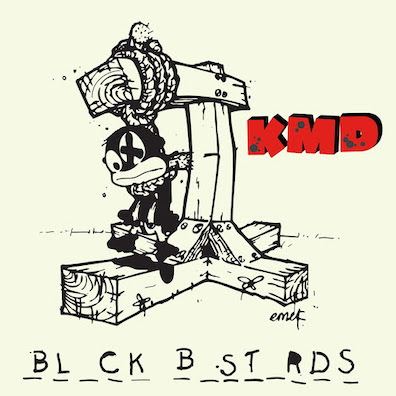
Two years later and one departed Onyx The Birthstone Kid later, KMD was distilled to the duo of brothers Subroc and Zev Love X. On April 23, 1993, DJ Subroc was hit by a car and tragically passed away at only 19 years old. Black Bastards was shelved after—surprise, surprise—Elektra realized they hadn’t signed some phony, easily marketable Arrested Development clone but a group that actually had something challenging to say. The opening moments set the scene: a sample collage exploring sex, violence, and the relationship between police with the African American community. The formerly fun-loving Zev Love X brags about his “brand new .280 in the box” as his “Get U Now.” The album cover features the lynching of a Sambo cartoon character, a striking visual that acts as a criticism of popular racist imagery of the past.
Of course, none of this was necessarily new ground for hip-hop. 1993 was the year of west coast G-funk, where Snoop Dogg and the solo remnants of N.W.A. reigned supreme. On the east coast, two of the most formative records of the decade dropped on the same day, with A Tribe Called Quest’s Midnight Mauraders and Wu-Tang Clan’s Enter The Wu-Tang. Black Bastards exists somewhere in between the jazz and grit of the two. The brothers were clearly more interested in comic books and cartoons than they were in old kung-fu flicks, and they didn’t quite have Tribe’s hooky chops for hit-making. But they had a distinct creative voice. Though X is clearly the more refined of the two MC’s, Subroc holds his own on “It Sounded Like A Roc,” and his production grooves to a mix of stripped-back bass lines, break beats, and playful vocal samples (“Why, why, why you keep smoking that shit?”).
The new vinyl re-release captures the rawness of the record. The packaging of the standard edition is utilitarian (plain black vinyl and no gatefold for you), but the actual pressing plays really clean. It’s of very similar quality to the 2010 Metal Face reissue, so if you already own that, there’s not much reason to seek this one out. However, if you’re willing to spend a little more money, the deluxe edition is pressed on red vinyl and has a gatefold.
Black Bastards wouldn’t receive a full release until 2000. In those intervening years, Zev Love X disappeared from the New York hip-hop community entirely until he reemerged in the late ‘90s wearing a mask and donning a new name, MF DOOM. Perhaps some of the record’s sonic rawness can be attributed to its tortured development, or perhaps it was all intentional, as a way of making the new KMD distinct from their cleaner sounding past.
Listening to Black Bastards in 2023, one might (and probably should) notice how much Subroc’s production style influences later DOOM records—the deployment of goofy samples, the way songs flow into one another so smoothly. Listen to DOOM’s Subroc tribute track “Kon Karne” after “Plumskinnz (Oh No I Don’t Believe It)” and you’ll discover the “hip-hop Hendrix” lives on through his older brother’s music. Black Bastards is often overlooked as a footnote in the origin story of hip-hop’s preeminent supervillain. But taken on its own merits 30 years later, the album stands as a testament to the creative drive of two brothers with an uncompromising vision of hip-hop and gives a glimpse into what could’ve been if Elektra hadn’t been too chickenshit to stand behind their own. Give it a listen. (www.gasdrawls.com)
Author rating: 8/10
Average reader rating: 7/10

Most Recent
- 500 to Go: Join Under the Radar’s Summer Subscription Campaign (News) —
- Premiere: Soft Loft Shares New Single “Wednesdays” (News) —
- You’ll Leave the City EP (Review) —
- Quicksand @ Rough Trade Below NYC, New York, US, July 17, 2026 (Review) —
- Premiere: Holy Pinto Shares New Single “Billboard” (News) —

Comments
Submit your comment
There are no comments for this entry yet.